
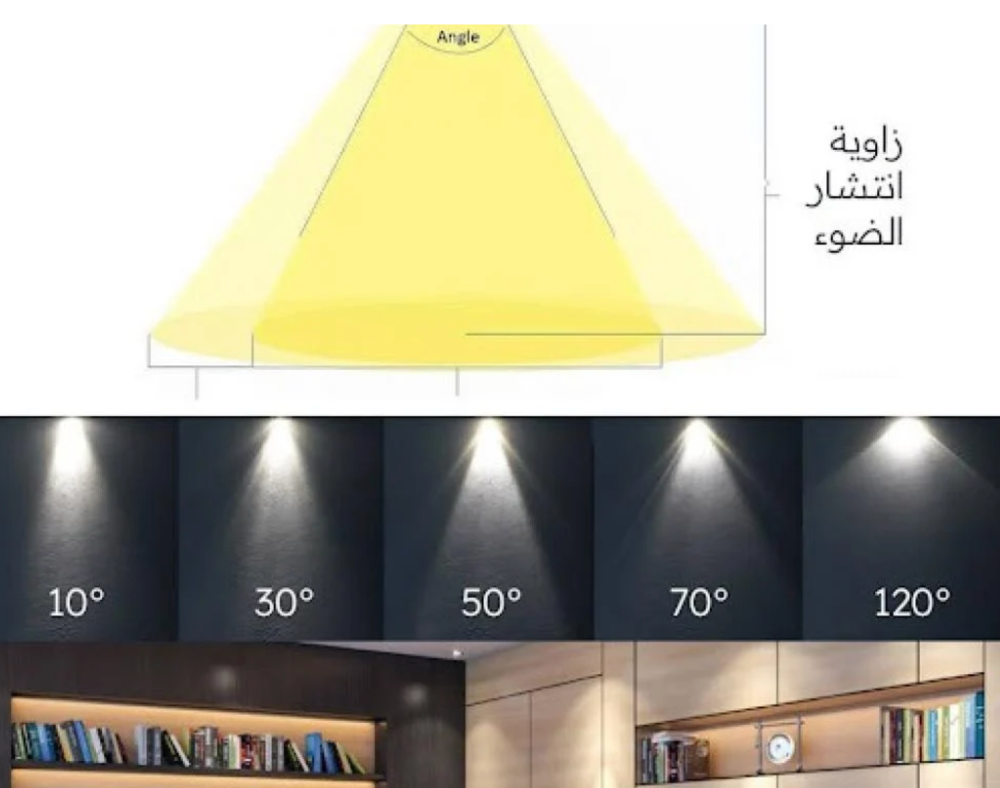
The angle of light distribution controls the overall lighting appearance of your space, and the effect of lighting on the interior design of the house.
Let's learn what it means, and how the magnitude of that angle varies depending on some different factors.
What does beam angle mean for lighting units?
Simply put, the angle of light is the width of the light spot emitted by the lamp, which always affects the appearance of walls, decorations, and the overall shape of the space.
The lighting angle usually varies from 10° to 360°, and each angle size has a specific use, of course…
Choosing light angles according to their purpose in lighting
The lighting angle of some modern lamps and spotlights depends on their intended use.
The smaller the illumination angle, the more concentrated the light is!
A small lighting angle works as a focused spot of light on a specific object only to highlight its details, or on a limited area to perform a specific task.
Examples of this include spotlights and pendant lighting that are directed at paintings, decorative elements, shelves, limited spaces, small hallways, etc.

The wide-angle, wide-spread lighting is used as general lighting in large, lively areas that require diffused lighting that is comfortable for the eyes.
For example, we use a wide diffusion angle downlight on the ceiling of the living room, in areas where we watch TV, in sitting rooms, and in relaxation areas.

The use of lighting angles is also affected by the height of your room's ceiling!
The angle of the light beam is affected by the distance between the lamp and the ground it is directed at, because the light spot scatters more the further it is from the surface.
If the ceiling height in children's rooms and bathrooms is low, it is preferable to choose a primary spotlight with a wide light angle of 60-120 degrees or more.
If the height is high in master bedrooms, halls, and living rooms, it is preferable to use interior lighting with narrow light angles of 20-45 degrees, for example.
For example, you can use GU10 spotlight bulbs, which are suitable for lighting high ceilings in the home, as they feature a 45° lighting angle.