
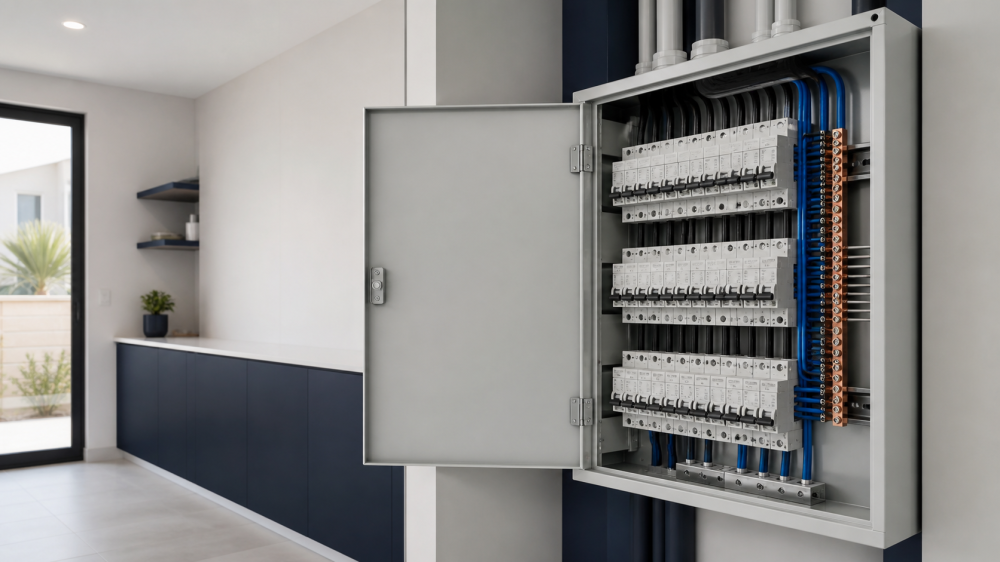
Quick answer: the right electrical distribution board is not simply the box with the most ways or the highest number printed on its main breaker. It is the panel that matches the site's supply, calculated loads, circuit plan, protective devices, installation environment and realistic future expansion. A qualified electrical professional should verify all of those points before purchase and installation.
This guide explains what to compare and which mistakes to avoid. With a professionally prepared schedule, you can 🔗 browse the electrical distribution board range at tirtk and match options to it.
Quick answer: how do you choose an electrical distribution board?
The short decision rule
Start with the approved electrical design, not the enclosure's appearance. Confirm the ways, supply arrangement, rated current, main device, branch protection plan, location, cable entries and spare capacity. The panel's physical layout must suit the installation; no single board size or breaker rating fits every project.
The quotation should state every included item. Some panels include a main breaker but no branch circuit breakers; others are empty enclosures. Confirming this before ordering prevents incomplete and misleading comparisons.
What an electrical distribution board actually does
Distribution and organization, with protection provided by devices
An electrical distribution board receives an incoming supply and organizes its distribution into outgoing circuits. It provides a controlled place for busbars, breakers, isolating devices and related accessories. The board itself houses and arranges these components; the correctly selected protective devices perform functions such as overcurrent, short-circuit or residual-current protection.
A strong metal enclosure alone does not create a safe system. Safety depends on conductors, earthing, load calculations, fault levels, device coordination, enclosure suitability and professional workmanship. The board is one part of an engineered installation.
How to read the key panel specifications
Number of ways and usable module space
A “way” generally serves an outgoing circuit, but panel formats differ. Some devices occupy multiple modules, and layouts may reserve space for the main breaker or accessories. Check the internal arrangement and genuinely usable positions instead of relying on the headline count.
Phase arrangement and site supply
The phase description must match the actual supply and design. Single-phase, two-phase and three-phase labels are not interchangeable. A professional should confirm incoming conductors, voltage arrangement, load balancing and device compatibility before the panel is chosen.
Rated current and main breaker
A current rating is not a recommendation for every building. The correct value depends on load calculation, supply capacity, cable sizes, installation conditions and protection coordination. Higher is not automatically better.
MCB and MCCB describe different breaker formats and capabilities. Breaking capacity, poles, trip characteristics and coordination matter alongside current rating. A qualified professional should specify them rather than guessing from appliance count.
Protection devices, enclosure and internal construction
A panel may accommodate MCBs, an MCCB, RCDs, RCBOs, surge protective devices or controls, each with a distinct purpose. You can 🔗 compare electrical circuit breaker options at tirtk, but selection must follow the approved schedule and applicable requirements.
Examine the enclosure, finish, door and mounting system. Use the exact model's published indoor or outdoor classification where dust, water, heat or corrosion is possible. Busbar material, cable entries, terminal access and DIN-rail compatibility also affect installation and maintenance.
Choosing a board for the intended setting
Homes and apartments
Residential selection begins with a circuit plan. Lighting, sockets, air-conditioning, water heating, cooking equipment and dedicated appliances may need separate circuits. The board requires enough usable space for specified devices and sensible future capacity.
Do not choose by property size alone. Similar apartments can have different loads due to cooking, air-conditioning, controls or future equipment. The survey and load schedule are more reliable than generic home-size labels.
Villas, offices, shops and small projects
Mixed-use premises may need greater segregation, labelling and expansion space. Offices can have dedicated IT and air-conditioning circuits; shops may add signage, refrigeration or shutters. Villas may use multiple panels. Their number and location should follow the design and cable routes.
For commercial sites, assess operating patterns, start-up characteristics, diversity, fault conditions and device coordination. This matters where continuity is important and one fault should not interrupt unrelated circuits.
How many ways and how much spare capacity do you need?
Count planned circuits, then allow practical expansion
Map every approved outgoing circuit to the module space its device occupies. Include the main device and specified residual-current or surge protection. This is more accurate than counting rooms because one room may contain several dedicated circuits.
No single spare-capacity percentage suits every project. Consider likely extensions, replacement difficulty and wall space. Reserve positions should be covered and documented; too little reserve complicates future work, while an oversized panel can waste space.
A published 8-way panel example: what the listing tells you
Reading the specification without making assumptions
One useful example is the 🔗 Alraed Alarabi 8-way, 2-phase panel with 63A European MCCB main breaker. Its published description states 220/240V, a cold-rolled steel enclosure, a tinned ETP copper busbar, RAL 7035 polyester powder coating, cable entries and ties, and compatibility with IEC DIN rails. It is presented for homes, apartments, villas, small offices and shops.
The crucial detail is that this model is sold without branch circuit breakers. Required outgoing breakers must be selected separately from the circuit design. The 8-way format and included 63A MCCB still need checking against the site's supply, conductors, loads and protection plan; a listing never replaces project-specific approval.
Common buying mistakes that lead to poor results
Choosing by enclosure size or amperage alone
A spacious cabinet may lack the required internal arrangement, and a larger ampere figure does not guarantee suitability. Compare supply, ways, usable modules, main device, busbar, cable access, mounting, location and coordinated protection. Ask about missing specifications before ordering.
Assuming every visible or mentioned device is included
Photos may illustrate a configuration rather than every included item. Confirm whether the panel is empty, includes a main isolator or MCCB, or contains outgoing devices. Verify accessories, terminals, covers and labels in writing.
Other mistakes include ignoring future circuits, using an indoor enclosure in an exposed area, skipping dimension checks and mixing unapproved devices. Physical rail fit alone does not prove electrical compatibility.
Buyer checklist and essential safety requirements
Information to prepare before requesting a quotation
• Approved single-line diagram or circuit schedule, where applicable.
• Incoming supply and phase arrangement confirmed for the site.
• Calculated design current, conductor details and required main device.
• Number of outgoing circuits and module space for each specified device.
• Required protective functions, poles and breaking capacities.
• Indoor or outdoor location and relevant environmental conditions.
• Maximum panel dimensions, mounting method and cable entry direction.
• Needed spare capacity and any planned future equipment.
• Clear list of included breakers, accessories and documentation.
Professional design, installation and testing are not optional
An electrical distribution board contains potentially lethal voltage and high fault energy. Installation, modification and energization are not DIY tasks. A qualified, appropriately licensed professional should follow the approved design and applicable Saudi requirements, verifying isolation, earthing, terminations, torque, labelling and device coordination.
The system should be inspected and tested before service. Keep labels legible and the panel accessible, dry and unobstructed. Heat, odour, buzzing, discoloration or repeated tripping requires prompt professional investigation, not repeated resetting.
Frequently asked questions about electrical distribution boards
Is an electrical distribution board the same as a breaker box?
“Breaker box,” “distribution panel” and “consumer unit” are often used conversationally for related equipment, but exact construction and terminology vary. Check the product specification and project documents rather than relying on the label alone. The important points are the supply arrangement, internal components, ratings and intended use.
Is a board with more ways always better?
No. More ways can provide useful expansion space, but the enclosure must still fit the location and match the planned devices. The best choice offers enough usable positions for the approved circuits and sensible future capacity without creating avoidable size, cost or installation problems.
How many ways does a house need?
There is no dependable answer based only on bedrooms or floor area. Count the designed circuits for lighting, sockets, air-conditioning and dedicated loads, then account for the module width of the specified devices and future plans. A qualified professional should produce or verify the schedule.
Does a 63A main breaker mean the building can always use 63A?
No. That marking describes the device rating, not an automatic allowance for every installation. Supply capacity, cable sizing, load calculation, installation conditions and upstream coordination determine whether it is appropriate. The rating must be confirmed as part of the full design.
What is the difference between an MCB and an MCCB?
Both are circuit-breaker families, but they differ in construction, available ratings, breaking capacities and adjustment options. The right choice depends on the circuit and system study. Neither should be selected from current rating alone, and one is not universally “better” than the other.
Are branch circuit breakers included with every panel?
No. Some products include only an enclosure, while others include a main device but no branch breakers. Always read the included-items statement and request written confirmation. The example in this guide includes a 63A MCCB main breaker but is expressly sold without branch circuit breakers.
Can I install an indoor panel outdoors?
Not unless the exact enclosure is documented as suitable for the environmental conditions and installation method. Outdoor exposure may involve rain, dust, heat, sunlight or corrosion. Ask for the published enclosure classification and have a professional confirm the location and any additional protection needed.
When should an existing distribution board be inspected?
Arrange professional inspection when circuits are being added, the property use changes, protective devices trip repeatedly, or there are signs such as heat, odour, buzzing or discoloration. Periodic inspection may also be required by the site's maintenance plan or applicable rules. Never remove covers to investigate an energized board yourself.
Choose with a circuit plan, not guesswork
The best electrical distribution board is the one that fits a verified design today and leaves practical room for tomorrow. Compare the number of ways, phase arrangement, rated current, main device, protective-device plan, construction, installation environment and included components as one coordinated package.
Once your electrical professional has confirmed those requirements, 🔗 compare electrical distribution boards available from tirtk. Use the checklist above to review each listing, confirm inclusions in writing and select the panel that matches the approved project specification.