
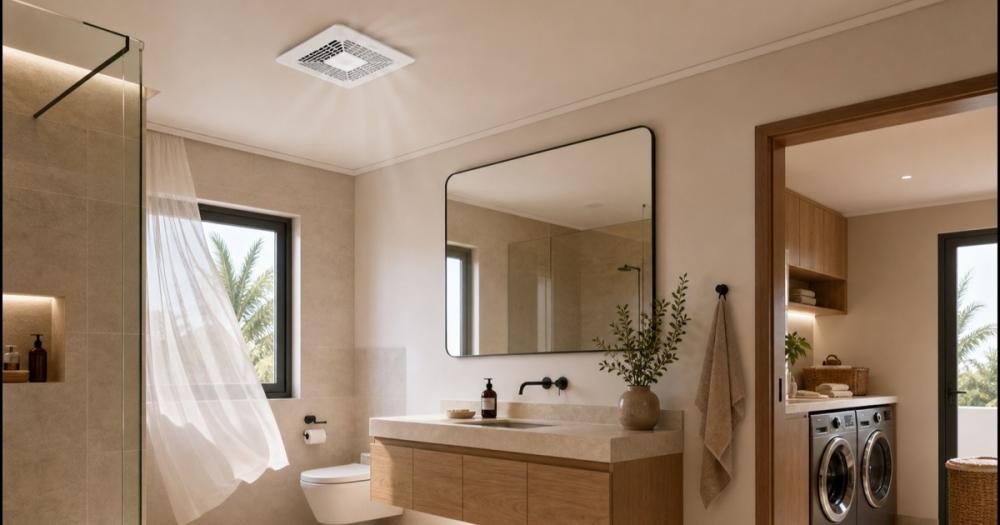
Choosing an exhaust fan starts with the airflow you need, the exhaust route, acceptable noise and the actual installation opening—not just the fan diameter or wattage. This guide explains bathroom and kitchen sizing, CFM and m³/h, duct resistance, mounting types and the checks that prevent a strong-looking fan from underperforming after installation.
Quick answer: how do you choose the right exhaust fan?
Choose by required airflow, mounting, duct resistance and a real outdoor discharge—not by the highest CFM alone. HVI bathroom guidance starts at 50 CFM for rooms up to 50 sq ft and about 1 CFM per sq ft up to 100 sq ft. Keep it running for about 20 minutes after use. This is selection guidance, not a substitute for Saudi requirements or a qualified installer’s assessment.
Browse ventilation and exhaust fans at tirtk
What is an exhaust fan, and when do you need one?
An exhaust fan removes humid, stale or odorous air from an enclosed room. It is useful when mirrors stay fogged, bathroom odours linger, kitchen heat accumulates, or a laundry or storeroom feels stuffy. This is especially relevant in closed, air-conditioned Saudi buildings and humid coastal areas.
The fan also needs makeup air through a door undercut, transfer grille or designed fresh-air path. Without it, airflow can fall and the fan may sound strained. The discharge must reach outdoors; sending damp air into a ceiling void merely moves the moisture problem.
Exhaust fan vs kitchen hood vs recirculation
A ducted kitchen hood captures smoke, grease and steam near the hob, then sends them outside. A recirculating hood filters air and returns it to the room; it may reduce some grease and odour but does not exhaust moisture. A general kitchen exhaust fan exchanges room air, yet cannot replace a suitable hood for grease-heavy cooking. Both may be used when makeup air and ducting are professionally planned.
Main exhaust fan types
Wall or window exhaust fans
A wall model offers a short route when an external wall is available. Check the cut-out, exterior grille, weather protection and backdraft shutter. Wall mounting does not imply glass compatibility; use a window model only when approved, with a glazing specialist handling the opening.
Ceiling exhaust fans
A ceiling model suits bathrooms or service areas when a duct can reach outdoors. Verify ceiling space, maintenance access, duct size and condensation risk. Never discharge moist air into the ceiling void.
Inline duct fans
An inline fan sits inside the duct and can suit longer routes or multiple pickup points. Its result depends on static pressure, duct diameter and bends—not free-air CFM alone.
Industrial and project exhaust fans
Warehouses, workshops and commercial kitchens need calculations for room volume, contaminants, heat, operating time and makeup air. Use a ventilation professional rather than choosing by residential fan diameter.
Specifications that actually matter
Airflow: CFM and m³/h
CFM means cubic feet per minute; m³/h means cubic metres per hour. One CFM is approximately 1.699 m³/h. Compare products in one unit and base airflow on a room calculation rather than “bigger is better.”
Duct and static pressure
A long or narrow duct, crushed flex duct, small outlet, dirty grille and repeated elbows add resistance. For a demanding route, ask for performance at static pressure: catalog free-air CFM may not equal installed airflow.
Noise
Compare published dB or sone ratings at a stated test point. Diameter and wattage cannot prove a fan is quiet, while a restrictive duct can create extra noise.
Fit, power and wet-area suitability
Confirm nominal size, face dimensions, cut-out and duct connection separately; “6 inch” does not guarantee a six-inch opening. Check voltage and frequency. In an exposed wet zone, use only a model with suitable published IP or wet-location approval, following manufacturer and local electrical requirements.
How to size a bathroom exhaust fan
Under HVI bathroom ventilation guidance, an intermittent fan for a bathroom up to 50 sq ft (about 4.65 m²) should provide at least 50 CFM. From 50 to 100 sq ft, use roughly 1 CFM per square foot. A 2 × 3 m bathroom is about 64.6 sq ft, so its starting guide is about 65 CFM. Larger bathrooms and enclosed toilets require further assessment.
Account for duct resistance, ceiling height and tested fan performance. Extract near the moisture source only if the model is approved there, provide replacement air, and ventilate for roughly 20 minutes after showering. HVI figures are guidance; applicable Saudi rules and manufacturer instructions take priority.
Read HVI bathroom ventilation guidance
Calculate the bathroom exhaust fan airflow
Choosing an exhaust fan for a kitchen
Start with the cooking source. A ducted hood normally provides primary capture; match its width, airflow and duct to the appliance and cooking style. A room fan is supplementary unless the design says otherwise. Strong exhaust without makeup air can reduce performance and affect combustion appliances, so higher CFM is not automatically safer.
Ceiling vs wall exhaust fan
Choose a ceiling fan when:
• A ceiling void and an outdoor duct route are available.
• The pickup point is best located overhead.
• Maintenance access and a short, smooth duct can be provided.
Choose a wall fan when:
• An external wall permits a short direct discharge.
• The opening can be weather protected and kept away from air intakes.
• The fan and shutter remain accessible for cleaning.
Neither type is always stronger or quieter. The better choice is the one that delivers the calculated airflow through the real duct system with safe access for maintenance.
A practical 6-inch exhaust fan example
Alraed Al Arabi 6-inch Turbo Exhaust Fan with 335 CFM
The product page publishes 335 CFM, 40 W, 110–240 V at 50–60 Hz, white finish, a two-year warranty and SKU RA-F1212002. It is presented for ceiling installation and listed for kitchens, bathrooms and service areas.
These figures support comparison but do not prove fit. The page does not publish sound, IP, cut-out, full dimensions or a pressure curve. Confirm those details before use in a wet zone or an existing opening.
Why an exhaust fan may feel weak
• The stated airflow is free-air performance rather than performance at duct pressure.
• The duct is long, narrow, crushed or has too many elbows.
• The grille is blocked or the backdraft shutter is stuck.
• There is no makeup-air path into the room.
• Connections leak or the fan is installed in the wrong direction.
• Dust has accumulated on the blades or the motor is faulty.
Inspect the complete route and clean only with power isolated. Electrical testing and motor diagnosis should be left to a qualified technician.
Common buying and installation mistakes
Do not choose by inch size alone, compare free-air CFM without considering the duct, call an unrated fan “silent,” vent into an attic, reduce the duct immediately, or cut glass for an unapproved model. Wet-zone equipment must have the relevant published approval. Oversizing without makeup air can also increase noise and reduce real performance.
Exhaust fan checklist
• Room use and calculated airflow.
• Ceiling, wall, window or inline mounting.
• Outdoor discharge and makeup-air paths.
• Duct diameter, length and bends.
• Face and actual cut-out dimensions.
• Airflow at relevant static pressure.
• Published noise rating.
• Voltage, frequency, wattage and controls.
• IP or wet-area approval where required.
• Warranty, cleaning access and installer scope.
Frequently asked questions
1. What size exhaust fan do I need for a bathroom?
Calculate airflow before diameter. HVI’s guide uses at least 50 CFM for the smallest bathrooms and about 1 CFM per sq ft up to 100 sq ft. Duct losses can change selection.
2. Is a 6-inch exhaust fan enough?
Possibly, but “6 inch” is nominal size, not room capacity. Compare published CFM with your need, then verify the cut-out, duct and pressure performance.
3. Are an exhaust fan and a ventilation fan the same?
The terms overlap, but ventilation can include exhaust and fresh-air supply. An exhaust-only fan still needs a replacement-air path.
4. Can I install a ceiling fan on a wall or glass?
Only if the manufacturer approves that orientation and surface. Glass needs a compatible model, correct opening and specialist handling.
5. Why does moisture remain while the fan runs?
It may be undersized, poorly placed or restricted by ducting. It may also lack makeup air or stop before moisture clears.
6. How long should a bathroom fan stay on?
HVI recommends about 20 minutes after use. A correctly installed timer or humidity control can make operation consistent.
7. Is higher CFM always better?
No. Excess airflow can increase noise, energy and makeup-air demand. Select enough delivered airflow for the room and duct.
8. Can a kitchen exhaust fan replace a range hood?
Not for capturing grease and smoke at the hob. A ducted hood captures pollutants at source; a room fan is usually supplementary.
Conclusion
Choose exhaust fans by calculated airflow, installed performance, duct resistance, noise and the real opening—not by diameter or watts alone. Confirm outdoor discharge and makeup air, then have a qualified installer verify the electrical and mechanical details. This approach gives better ventilation and avoids buying a fan that only appears powerful on paper.
Compare exhaust and ventilation fans at tirtk