
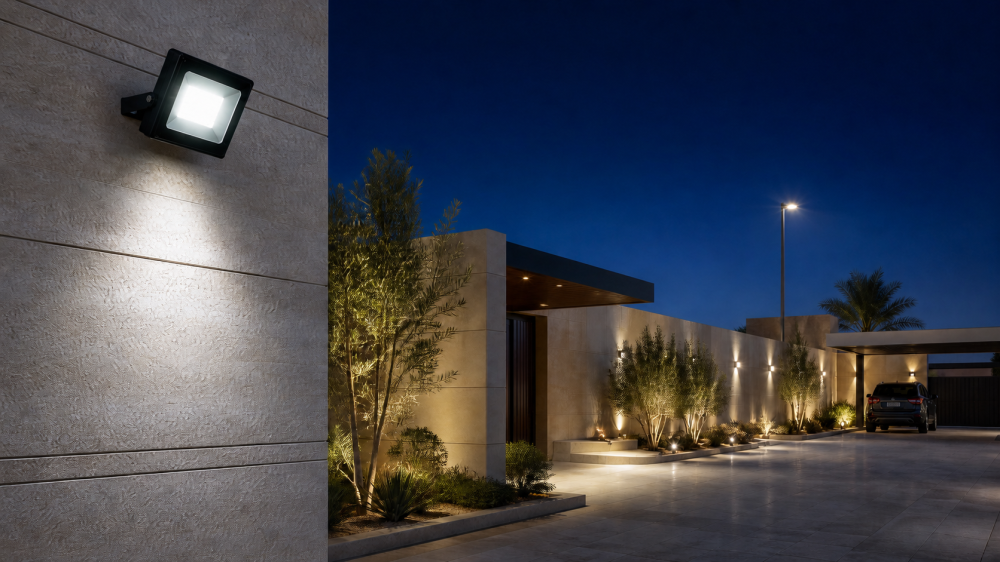
Choosing outdoor lighting by wattage alone often produces the wrong result: bright patches, dark gaps, unnecessary glare, or more fittings than the site needs. This LED floodlights buying guide explains how to compare light output, beam shape, weather protection, colour temperature, mounting height, and application before selecting a fixture.
Scope note: this guide covers fixed luminaires used on buildings, yards, car parks, roads, warehouses, and project sites. It does not cover handheld flashlights, portable torches, or automotive headlights.
The short answer is simple: select a light by the required lumens and distribution on the target surface—not by watts alone. Then check the mounting height, beam angle, IP rating, colour temperature, voltage, driver quality, and expected operating conditions. If you already know the application and want to compare available fixture families, you can 🔗 browse fixed outdoor lighting types while using the criteria below as your checklist.
Start with the application, not the product name
“Floodlight” is sometimes used as a catch-all term, but different optical systems solve different problems. A general floodlight spreads light across a façade or open area. A street light sends a controlled pattern along a road. A high-bay fixture directs light downward from a high ceiling. A solar fixture combines a luminaire with a panel, battery, and control system. Treating these as interchangeable can reduce uniformity and create glare even when the total lumen figure looks impressive.
LED floodlights
LED floodlights are useful for façades, yards, entrances, signs, loading areas, and open spaces. Their adjustable aiming and broad output make them flexible, but the beam must remain on the intended surface. A powerful fitting aimed too high can waste light into the sky or shine into neighbouring properties.
Street lights
Street luminaires are designed for roads, driveways, long paths, and some car parks. Their optics should push light along the route rather than create a circular pool below the pole. For a project, ask for photometric data and evaluate spacing, pole height, overhang, uniformity, and glare together.
Solar floodlights
Solar lighting can reduce trenching and cabling at remote locations, but performance depends on usable solar exposure, panel size, battery capacity, control settings, and required hours of autonomy. Do not compare solar products by a large marketing watt figure alone; verify actual lumens and the operating schedule at full and reduced output.
UFO and high-bay lights
UFO or high-bay fixtures suit warehouses, workshops, sports areas, and other high ceilings. Their downward distribution, thermal design, and available beam options differ from a wall-mounted floodlight. Mounting one too low can cause uncomfortable brightness and poor visual comfort.
Seven specifications that determine the right LED floodlight
1. Lumens, watts, and efficacy
Lumens (lm) describe the total light emitted; watts (W) describe electrical input. Their ratio, lumens per watt (lm/W), is a useful efficiency indicator, but it does not reveal beam quality, glare, driver reliability, or how much light reaches the work plane. Compare verified lumens first, then use wattage to estimate energy demand.
2. Beam angle and distribution
A narrow beam concentrates light over a smaller area and can reach farther; a wide beam covers more area but delivers less intensity at any one point. The correct choice depends on distance, mounting height, tilt, and target dimensions. For roads or large projects, an IES or LDT photometric file is more useful than a beam-angle number by itself.
3. IP protection
The first digit in an IP rating describes protection from solid particles; the second describes water ingress protection. IP65 indicates dust-tight construction and protection against water jets. It does not mean the fixture can be submerged. IP66 provides protection against more powerful water jets, but installation details, seals, cable entries, and manufacturer instructions still matter.
4. Colour temperature
Around 3000K appears warm, 4000K appears neutral, and 6500K appears cool white. Warm or neutral light may feel more comfortable near homes and hospitality spaces; cooler light is often chosen for functional outdoor areas. The best option depends on visual tasks, surrounding finishes, local requirements, and the effect on neighbours—not simply on which colour looks brightest.
5. CRI
The colour rendering index indicates how naturally colours appear under a light source. CRI 80 is a common baseline for general utility lighting. Areas used for inspection, retail display, colour matching, or cameras may justify a higher requirement, subject to the full lighting design.
6. Mounting height, aiming, and uniformity
Higher mounting can enlarge coverage but reduces illuminance on the ground. Aiming changes both useful light and glare. Good design considers average lux, minimum lux, uniformity, shadows, and direct view of the light source. Two layouts with equal total lumens can therefore perform very differently.
7. Driver, voltage, heat, and documentation
Confirm that the voltage range matches the supply and review the driver, surge protection, body material, thermal path, warranty terms, and ambient-temperature limits. For a serious project, request a datasheet and photometric file. Product life claims should be read as rated values under stated conditions, not as a promise that every installation will reach the same hours.
Quick comparison of fixed lighting types
LED floodlight
Best suited to: façades, yards, entrances and signs.
Main strength: flexible aiming and broad coverage.
Check carefully: lumens, beam, IP rating and glare.
Usually not ideal for: road optics or very high ceilings without a calculation.
Street light
Best suited to: roads, long paths and parking lanes.
Main strength: controlled longitudinal distribution.
Check carefully: pole height, spacing, optics and the photometric file.
Usually not ideal for: general façade washing.
Solar fixture
Best suited to: remote sites and off-grid paths.
Main strength: reduced cabling and trenching.
Check carefully: real lumens, panel, battery, autonomy and shade.
Usually not ideal for: shaded sites or continuous high-output duty without verification.
UFO / high bay
Best suited to: warehouses and high ceilings.
Main strength: efficient downward distribution.
Check carefully: height, beam option, heat and actual lumens.
Usually not ideal for: low ceilings or eye-level mounting.
How to choose by location
• Home yard or façade: prioritise controlled aiming, visual comfort, suitable colour temperature, and an outdoor IP rating. More brightness is not always better near windows or neighbours.
• Car park or open plaza: design for uniformity and pedestrian visibility, not isolated bright pools. Check pole positions, shadows between vehicles, and glare toward drivers.
• Road or long walkway: use street-light optics and verify spacing through photometric calculation rather than substituting a generic wide floodlight.
• Warehouse: match high-bay beam and output to ceiling height, aisle layout, rack shadows, and the task performed below.
• Remote or agricultural site: assess solar access by season, battery autonomy, cleaning needs, and the desired operating profile before choosing solar.
How to estimate lumens and fixture quantity
Illuminance is measured in lux, or lumens reaching each square metre. As a first planning estimate:
Initial lumen estimate = target lux × area in m²
Example: 100 lux across 200 m² starts at 20,000 lumens reaching the plane—not necessarily 20,000 lumens at the fixtures.
Real installations lose light through optical efficiency, distance, dirt, ageing, surface reflectance, and spill outside the target. Designers account for these effects with utilisation and maintenance factors, then test mounting positions and beam distributions. Use the 🔗 lighting layout, lux, and spacing calculator for a preliminary comparison, and use a qualified lighting designer for safety-critical roads, sports areas, industrial work, or compliance-sensitive projects.
Worked example: reading one verified street-light specification
Consider this 🔗 150W LED street light with 21,000 lm output. Its current listing states 6500K, CRI 80, IP66, a 120° beam, an 85–265V input range, an aluminium body, and dimensions of 660 × 240 × 155 mm. Dividing the listed output by input power gives a calculated efficacy of 140 lm/W. That calculation helps compare energy performance, but it does not replace a photometric layout: pole height, road width, optics, aiming, and spacing determine where those lumens land. The listing also states a rated 50,000-hour life and a five-year warranty; confirm current terms and installation conditions before purchase.
Common buying mistakes
• Choosing by watts only: equal-watt products can deliver different lumens and distributions.
• Assuming brighter is always safer: excessive contrast and glare can make obstacles harder to see.
• Treating IP65 as waterproof for every condition: it does not certify immersion, and poor cable entries can compromise an installation.
• Ignoring mounting height and aiming: catalogue output alone cannot predict ground-level lux.
• Buying solar by advertised watts: panel, battery, verified lumens, autonomy, and sun exposure are the meaningful checks.
• Skipping documentation: projects need coherent datasheets, warranty terms, and photometric information.
Pre-purchase checklist
• Define the area, task, target lux, and operating hours.
• Record mounting height, spacing limits, and possible aiming directions.
• Compare verified lumens, beam distribution, efficacy, CRI, and colour temperature.
• Match the IP rating, temperature limits, materials, and cable entry to the environment.
• Check voltage, driver, surge protection, warranty, datasheet, and photometric file.
• Review glare, spill light, maintenance access, controls, and installation cost.
Electrical safety: fixed outdoor luminaires should be installed by a qualified electrician in accordance with the product instructions and applicable regulations. Isolate the supply before work, provide suitable earthing and protection, use correctly rated cables and glands, and never modify a sealed fitting to force an unsuitable installation.
Frequently asked questions
1. How do I choose the correct floodlight wattage?
Start with the required lux, area, mounting height, and beam distribution. Estimate lumens first, then compare wattage and lm/W among fixtures capable of producing the required layout.
2. What is the difference between watts and lumens?
Watts measure electrical input; lumens measure total light output. Neither alone describes glare, beam shape, uniformity, or the amount of light reaching the ground.
3. Is a 100W LED floodlight enough for a yard or car park?
There is no universal answer. The fixture's actual lumens, beam, height, tilt, area, target lux, and competing ambient light all affect the result. A layout calculation is more reliable than wattage.
4. Does IP65 mean a light is suitable for rain?
IP65 covers dust ingress and water jets under the test definition, so it is commonly used outdoors. It does not cover submersion, and the complete installation must preserve the rating.
5. Should I choose 3000K, 4000K, or 6500K?
Choose according to the task and surroundings. 3000K is warm, 4000K neutral, and 6500K cool white. Consider comfort, visibility, façade colour, cameras, neighbours, and project requirements.
6. What is the difference between a floodlight and a street light?
A floodlight generally provides adjustable broad illumination. A street light uses optics intended to distribute light along roads and paths. The latter is usually the better starting point for pole-mounted roadway layouts.
7. Are solar floodlights better than mains-powered lights?
They are advantageous where cabling is difficult and solar exposure is reliable. Mains power may suit long operating hours or consistently high output. Compare lifetime system needs, not only purchase price.
8. How many floodlights do I need?
Calculate from target lux and area, then adjust for utilisation, maintenance, height, beam, and layout. Several moderate fixtures may deliver better uniformity than one extremely bright fitting.
9. Which fixture is suitable for a high warehouse?
A high-bay or UFO fixture is often appropriate, but the selection depends on ceiling height, aisles, racking, work-plane lux, beam angle, heat, dust, and control requirements.
10. Do outdoor lights need professional installation?
Yes. Outdoor electrical work involves supply isolation, earthing, circuit protection, environmental sealing, secure mounting, and compliance considerations that should be handled by a qualified electrician.
Make the final choice from evidence
A strong lighting decision connects the site requirement to measurable performance: useful lumens, a suitable beam, controlled glare, correct protection, reliable electrical components, and a maintainable installation. Record those requirements before comparing products, and request a photometric study when the area is large or safety-critical. When you are ready to shortlist the correct family, 🔗 compare the outdoor lighting options available from tirtk against this checklist.