
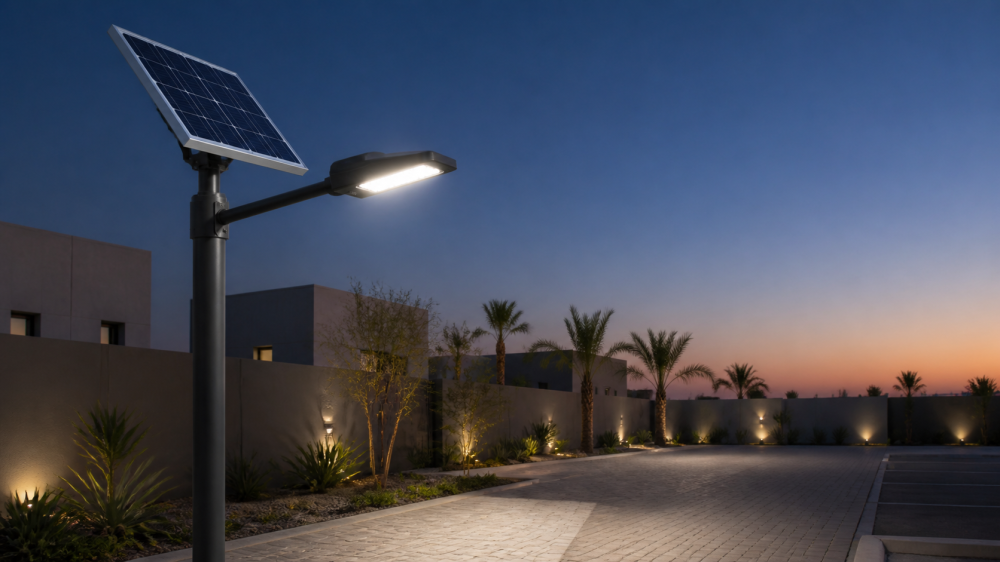
Choosing solar flood lights for a Saudi home, farm, car park, entrance, or road is not simply a matter of selecting the largest watt number. Start with measured light output, the area to be covered, the beam shape, and the hours when light is needed. Then check whether the panel and battery are clearly specified and the location receives dependable direct sun.
This guide explains how to evaluate solar outdoor lights honestly in Saudi conditions, where heat, dust, seasonal sun angles, and nearby shade can change real performance. Use it to prepare a shortlist, then 🔗 compare solar outdoor lighting options at tirtk by their published specifications rather than by one headline figure.
What a solar lighting system actually includes
The light is only one part of the system
A solar luminaire combines LED modules with a photovoltaic panel, a rechargeable battery, a controller, and usually a dusk sensor. The panel collects energy during useful daylight, the controller manages charging and operation, and the battery supplies the LEDs after dark. A strong LED specification cannot compensate for a poorly positioned panel or an undersized energy-storage system.
Integrated and separate-panel designs solve different problems
An integrated unit places the principal components together and avoids grid electrical extensions. A separate-panel design lets the panel face better sun while the luminaire aims elsewhere, but adds cables and mounting points. Neither format is automatically superior; the site decides.
Start with useful light, not advertised watts
Lumens describe light output
Lumens indicate the total visible light emitted. Watts normally describe electrical power, but large watt claims on some solar products may be naming conventions rather than measured LED input. When a listing gives both an advertised watt value and a lumen value, use the lumens as the clearer starting point for brightness, then assess how the optics distribute that light.
Beam angle controls where those lumens go
A wide beam can cover a broader nearby area, while a narrower distribution can concentrate light farther away. Mounting height, tilt, setbacks, obstructions, and the dimensions of the target all affect the result. One intense patch below a fitting does not mean a car park or yard is evenly illuminated; dark gaps and glare matter too.
Colour temperature and CRI affect visual quality
Colour temperature is expressed in kelvin. A 6500K source appears cool white, while lower values appear more neutral or warm. CRI indicates how naturally colours appear under the light; CRI 80 is a common level for general-purpose lighting. Around homes, consider comfort, windows, neighbours, cameras, and the surrounding architecture alongside apparent brightness.
Read the solar panel and battery specifications together
Panel voltage and wattage need clear documentation
The panel rating helps identify how the system is intended to harvest energy, but a rating alone cannot predict daily charging. Panel direction, tilt, cleanliness, temperature, shade, season, and local weather all affect available energy. Compare products only when the panel specification is explicit, and avoid assuming that daylight behind a wall or tree is equivalent to direct solar exposure.
Battery voltage and amp-hours are not a runtime promise
A battery may be described by voltage and amp-hour capacity. These values are useful for comparing documented systems, but operating time also depends on light level, control mode, battery condition, temperature, charging achieved that day, and permissible depth of discharge. Fixed all-night or charging-time claims should be treated as conditional unless the test conditions and operating profile are stated.
Design for Saudi sun, shade, heat, and dust
Check the solar window, not only the daytime view
Visit the mounting point at different times or study its sun path. Parapets, trees, signs, poles, adjacent buildings, and even part of the luminaire can cast shade. The sun angle changes through the year, so a panel that looks clear in one season may receive less useful exposure in another. Prioritise an unobstructed orientation over visual symmetry.
Heat affects every enclosed component
Saudi summer conditions can raise an enclosure above the surrounding air temperature. Review stated ambient limits and mounting instructions, allow required clearances, and avoid locations that trap additional heat. Battery ageing, LED output, charging behaviour, and electronics can all be affected.
Dust makes maintenance part of the design
Dust on the panel reduces harvested energy, while dirt on the optical cover reduces useful light. Choose a position that can be inspected and cleaned safely. Frequency depends on wind, construction, agriculture, traffic, and rainfall; inspect more often when deposits build quickly.
Choose the right format for the location
Homes, entrances, and gardens
For a gate, path, courtyard, or façade, controlled light is usually more valuable than maximum output. Keep the beam out of windows and neighbouring properties and avoid eye-level glare. A separate panel may help below an awning; an integrated fitting can suit a clear, sunny wall or pole.
Farms, yards, and remote buildings
Solar flood lights can be useful where trenching and grid extensions are impractical. Define whether the purpose is navigation, a work task, animal-area observation, or general security awareness. Each requires a different light level and distribution. Protect equipment from vehicle impact and make sure maintenance access does not require unsafe climbing or work near machinery.
Parking areas, streets, and long routes
Roads and car parks need uniformity, glare control, pole spacing, and appropriate optics—not isolated bright circles. For these applications, 🔗 review the dedicated street-light category at tirtk and request a professional photometric layout when visibility or compliance is important. General-purpose flood optics should not automatically replace road-distribution optics.
Understand IP ratings and physical construction
IP65 does not mean fully waterproof
The first IP digit describes protection against solid-particle ingress and the second describes protection against water ingress under defined tests. IP65 indicates dust-tight construction and protection against water jets; it does not certify immersion, flooding, or every installation orientation. Seals, cable entries, connectors, covers, and assembly must remain intact to preserve the intended protection.
Mounting hardware is a safety specification
Check the bracket, pole diameter or wall fixing method, fasteners, wind exposure, corrosion conditions, and total assembly weight. Outdoor equipment should remain secure through weather and vibration. A qualified installer should select anchors for the actual substrate and follow the product instructions; improvised brackets or drilled modifications can weaken the unit and compromise ingress protection.
A published product example: how to read the numbers
The listing for the 🔗 Alraed Alarabi 400W advertised solar street light states 2400 lm, a 120° beam, CRI 80, 6500K, and IP65. It also lists a 5V 23W solar specification, a 3.2V 24AH battery, an integrated solar panel, and a published size of 890 × 280 × 56. The listing identifies streets, squares, parking areas, entrances, and roads as uses and states that grid electrical extensions are not required.
Do not treat the advertised 400W name as verified continuous LED input or use it to estimate brightness. The listed 2400 lm is the more relevant output figure, while 120° describes a broad nominal beam. A real layout must still account for pole height, spacing, aiming, obstructions, dimming, and required surface illumination.
Safe mounting and practical maintenance
Solar does not mean risk-free. Luminaires and panels may be heavy, batteries store energy, poles are exposed to wind, and work at height can cause serious injury. Use a qualified professional for structural fixing, pole work, access equipment, aiming, and any connection or service task. Follow the manufacturer instructions and applicable local requirements, and never open, modify, or bypass a sealed battery or controller.
• Before installation: confirm the sun path, target area, mounting surface, safe access, and the absence of hidden services.
• After installation: inspect the result after dark for dark gaps, glare, spill light, and unexpected shadows.
• During maintenance: isolate or disable the system as instructed, use safe access equipment, and inspect brackets, seals, panel cleanliness, optics, and visible damage.
• When performance changes: check shade, dirt, settings, physical damage, and battery condition through approved service procedures rather than guessing from the watt label.
Common mistakes and a better buying checklist
Common mistakes include buying by advertised watts alone, placing the panel in partial shade, treating IP65 as immersion-proof, aiming a wide beam into windows, overlooking summer heat, and expecting the same output through every hour and season. Another frequent error is using a single bright fitting where several correctly spaced lights would provide better uniformity.
• Define the area, purpose, desired operating periods, and whether reduced output is acceptable.
• Compare published lumens, beam angle, colour temperature, and CRI.
• Record panel voltage and wattage, battery voltage and amp-hours, and available control modes.
• Verify direct-sun access through the year and allow safe cleaning access.
• Check IP meaning, construction, temperature limits, mounting hardware, and warranty terms.
• For roads or large parking areas, request photometric evidence and professional spacing advice.
• Confirm what is included and whether parts, battery service, and technical support are available.
Frequently asked questions about solar flood lights
Are higher-watt solar flood lights always brighter?
No. A large advertised watt figure may be a product name or marketing class rather than measured LED input. Compare stated lumens, beam distribution, mounting height, and documented operating modes to judge usable light.
How many lumens do I need?
There is no universal figure. It depends on area, visual task, mounting height, beam, surface colours, surrounding light, uniformity, and required lux. A professional layout is appropriate for roads, workplaces, and large sites.
Does IP65 make a solar light fully waterproof?
No. IP65 addresses dust and water jets under test conditions. It does not cover immersion or flooding, and incorrect mounting, damaged seals, or modified cable entries can undermine the enclosure's protection.
How long will a solar light run at night?
Runtime varies with the energy collected, battery condition and capacity, temperature, brightness mode, dimming schedule, and hours of darkness. Treat any runtime statement as conditional on its stated test and operating conditions.
Will a solar panel charge in shade?
It may collect some energy in bright conditions, but shade can substantially reduce useful generation. Select a location with dependable direct sun and consider seasonal shadows from buildings, trees, signs, and parapets.
Is 6500K suitable for a home?
6500K provides a cool-white appearance often chosen for functional areas. For homes, also consider comfort, façade appearance, glare, bedroom windows, neighbours, and local preferences; a lower colour temperature may feel less harsh.
Are integrated solar street lights better than separate-panel lights?
Integrated units are compact and reduce external connections. Separate panels allow independent solar orientation. The better choice depends on shade, aiming direction, mounting space, service access, wind exposure, and the documented system specification.
Can solar outdoor lights replace grid lighting everywhere?
No. They are valuable where solar exposure is reliable and grid extensions are difficult, but shaded sites, demanding operating schedules, or critical illumination may require a different or hybrid design based on a proper assessment.
Who should install a pole-mounted solar light?
A qualified professional should evaluate the pole or substrate, wind loading, anchors, work-at-height access, orientation, aiming, and service safety. Follow manufacturer instructions and applicable local requirements.
Make the final choice from complete evidence
The best solar flood lights are the ones whose documented output, optics, energy components, controls, construction, and installation conditions match the site. Start with the required illumination, then test the solar location and maintenance plan before choosing a model. When your checklist is ready, 🔗 browse tirtk solar outdoor lights for homes and projects and compare each published specification in context.