
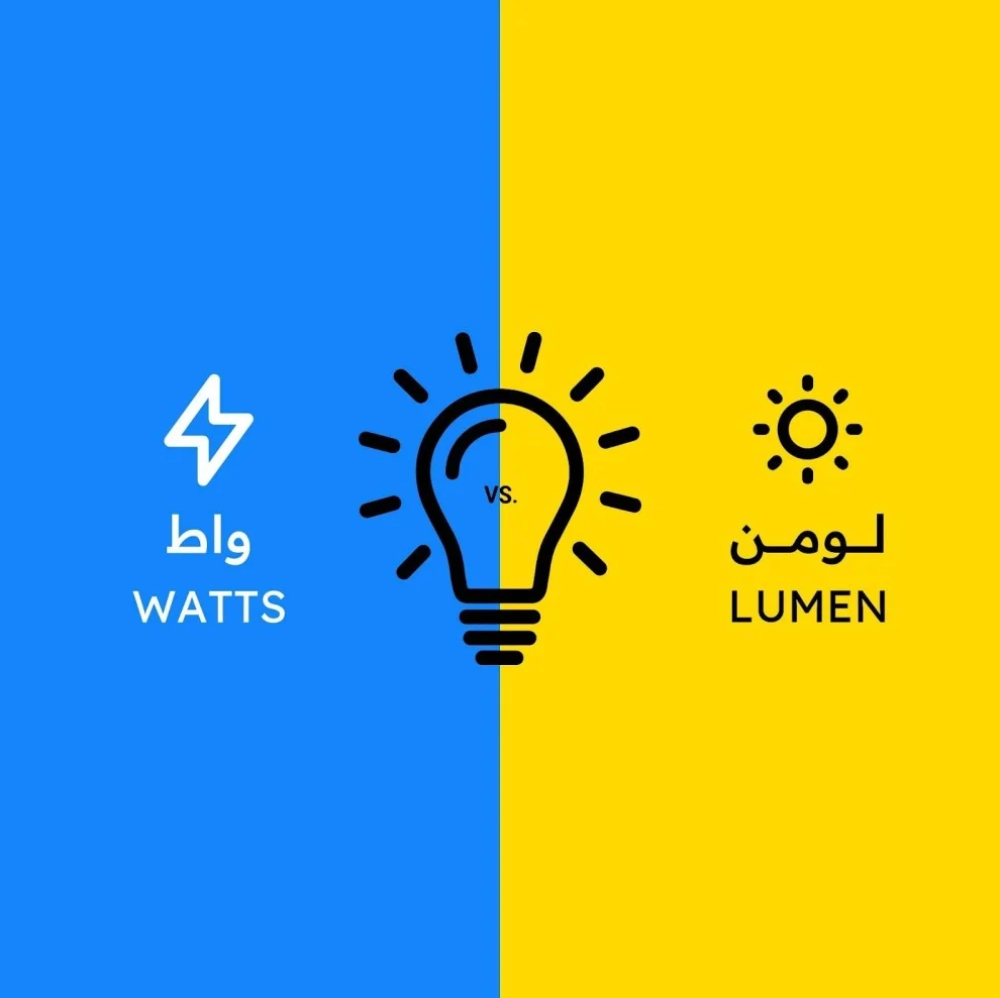
The core difference: lumens measure the amount of light (brightness) your eye sees, while watts measure electrical power consumption. When choosing lighting for your space, rely on lumens to set brightness and watts to gauge savings—not the other way around.
Quick answer: Lumens = brightness, watts = consumption. A low-watt LED can give higher lumens (brightness) than a high-watt traditional bulb. Choose by the lumens your space needs.
What is the difference between lumens and watts?
- Lumen (lm): the actual light output—the more, the brighter.
- Watt (W): the power consumed—the more, the higher the electricity use.
We used to tie brightness to watts because bulbs had similar efficiency; with LED, lumens became the correct measure of brightness.
Why not choose by watts?
Because LED efficiency made watts misleading: a 10W LED can equal a 60W traditional bulb in brightness. Relying on watts alone may give you weaker lighting than expected.
Approximate equivalence table (LED vs traditional)
- ~450 lumens ≈ 5–6W LED ≈ 40W traditional.
- ~800 lumens ≈ 8–10W LED ≈ 60W traditional.
- ~1100 lumens ≈ 10–13W LED ≈ 75W traditional.
- ~1500 lumens ≈ 12–15W LED ≈ 100W traditional.
How do they affect choosing lighting for your space?
- Determine the lumens needed by the space area and function.
- Choose a lamp that delivers those lumens.
- Look at watts to estimate consumption and savings.
- Compare efficiency (lumens per watt) to pick the most economical.
Luminous efficacy: lumens per watt
An indicator combining both: the higher the lumens per watt (lm/W), the more brightness you get for less power. LED excels here with high efficiency.
Tips when buying
- Look for the Lumen value on the box first.
- Use watts to estimate the electricity bill.
- Prefer a high lm/W for savings.
- Mind color temperature and CRI alongside lumens.
Frequently asked questions
Do higher watts mean higher brightness?
Not necessarily; brightness is measured in lumens, watts in consumption.
How many lumens equal a 60W traditional bulb?
About 800 lumens.
What matters most when choosing lighting?
Lumens first to set brightness, then watts and efficiency for savings.
Conclusion
Lumens measure brightness and watts measure consumption. To choose lighting for your space correctly, set the required lumens first, then pick the most efficient (high lm/W) for savings. That gives you ideal, economical lighting.
Related: Understand lumens vs watts when buying lighting, LED downlights, and floodlights at tirtk.