
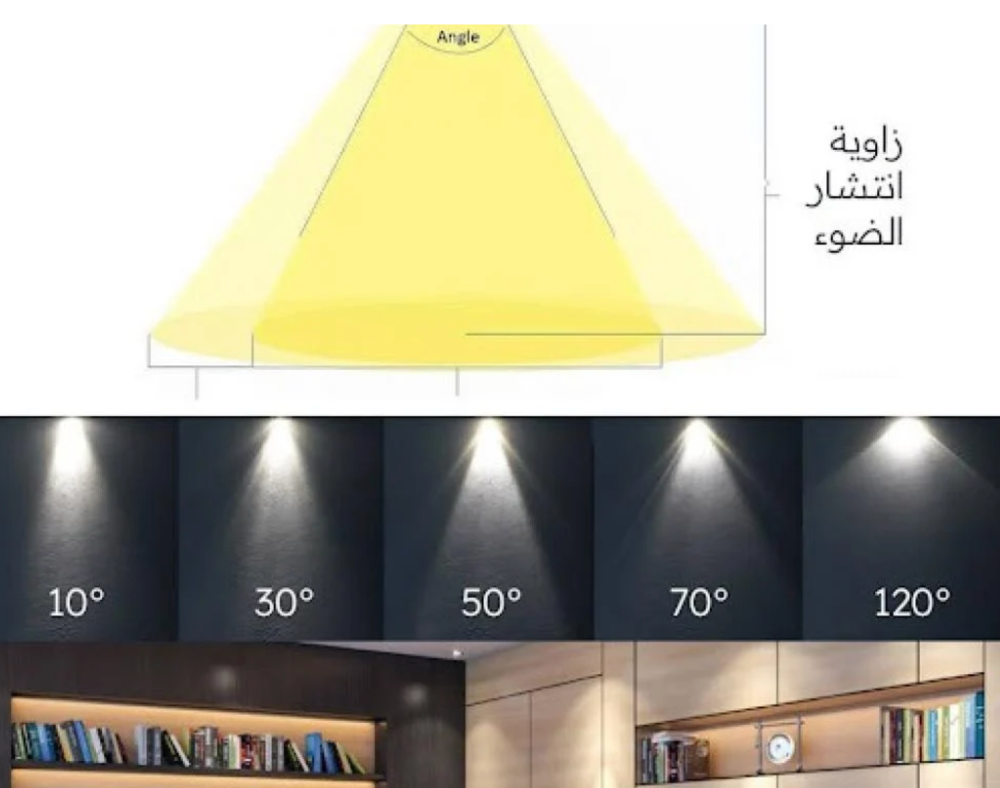
The beam angle is the angular spread of the light coming out of a fixture, measured in degrees. Choosing it correctly determines the light coverage and its intensity on a surface, and it depends on ceiling height, the lighting function, and the spacing between fixtures.
Quick answer: A narrow angle (15–24°) concentrates light for accenting; a wide one (60–120°) spreads it for general lighting. The higher the ceiling, the narrower the angle you should prefer to preserve intensity.
What is beam angle?
It is the angle at which the beam expands from its source until it reaches the surface. A narrower angle gives a smaller, more intense spot; a wider one gives a larger, less intense spot.
Types of beam angles
- Narrow (15–24°): for accent and focus (artwork, columns).
- Medium (25–45°): balanced general use.
- Wide (60–120°): for general lighting and wide coverage.
How the angle affects lighting
- On intensity (lux): a narrower angle concentrates light, raising intensity.
- On coverage: a wider angle covers a larger area at lower intensity.
- On distribution: it drives the number of fixtures and their spacing.
Factors that influence the angle choice
- Ceiling height: high ceilings need a narrower angle to keep intensity.
- Lighting function: accent = narrow, general = wide.
- Spacing between fixtures: a wide angle allows larger spacing.
- Aesthetic goal: a focused spot or soft distribution.
Tips for choosing the angle
- For general home lighting: a relatively wide angle.
- To highlight a feature: a narrow angle.
- For high ceilings: reduce the angle to keep brightness on the floor.
- Balance angle and spacing to avoid dark spots.
Frequently asked questions
What angle suits general lighting?
Usually 60° or more for even coverage.
What angle suits accenting?
Narrow, about 15–24°, to concentrate light.
Is a wider angle always better?
No; it gives more coverage but lower intensity, so choose by goal and height.
Conclusion
Beam angle is a core element of lighting design: it determines intensity, coverage, and distribution. Choose the angle by ceiling height, lighting function, and spacing for a balanced, elegant result.
Shop spotlights in various beam angles at tirtk Lighting & Electrical
Related: Beam angle matters for downlights, floodlights, and magnetic track lights at tirtk.