
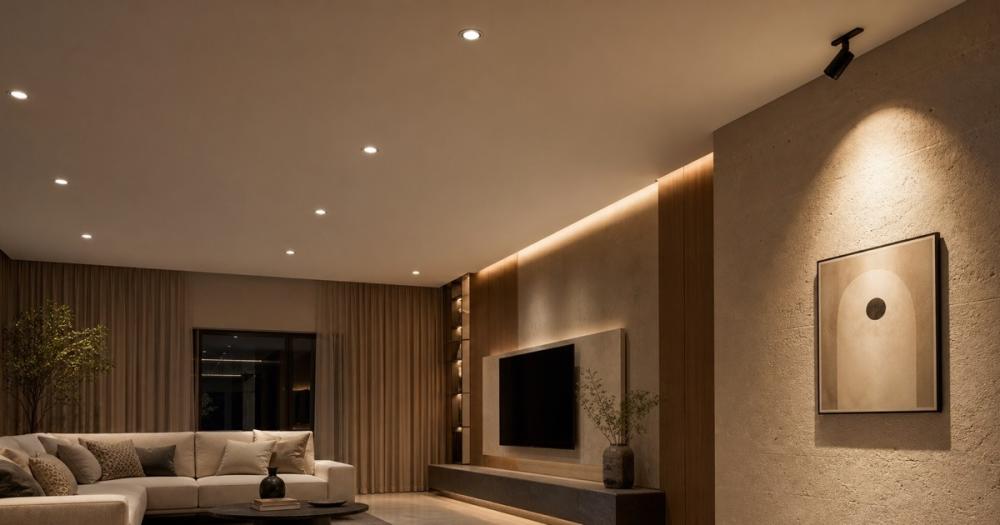
When searching for a spotlight, you will find GU10 bulbs, integrated LED fittings, recessed and surface-mounted spots, anti-glare trims, and adjustable track lights. These products all direct light, but they differ in brightness, beam angle, light colour, and installation method. That is why appearance or wattage alone is not enough when choosing a spotlight.
Quick answer: Choose a ceiling spotlight by its lumens, beam angle, colour temperature, CRI, and cut-out size, then match its base, voltage, and protection rating to the installation location. Warm light around 3000K is a common choice for living rooms and bedrooms, while a colour temperature closer to 4000K suits many kitchens and work areas. The final choice, however, should reflect the room's purpose and the other layers of lighting.
This guide explains the difference between spotlights and downlights, what the numbers on the packaging mean, and how to choose the right type for a home or office, with a practical example from tirtk.
◆ What Is a Spotlight?
A spotlight is a common description for a light fitting that directs light towards a defined area or object more deliberately than broad general lighting. It may highlight artwork, a wall, or a product display, or it may be arranged across a ceiling to provide both functional and decorative lighting.
The name does not mean that every spotlight produces an extremely narrow beam, nor does it mean that every model has an integrated LED source. Some spotlights use a replaceable bulb such as GU10, some contain an integrated LED source and driver, and some products marketed as spotlights are technically closer to wide-beam downlights. Always read the specifications instead of relying on the product name alone.
◆ What Is the Difference Between a Spotlight and a Downlight?
- Spotlight: Usually produces more concentrated light, may be adjustable, and is commonly used to highlight details or create intentional pools of light.
- Downlight: Usually directs light downwards across a wider area and is commonly used to create even general illumination.
- The name alone does not define the difference: The beam angle and optical design reveal whether the light is concentrated or widely distributed.
- In a well-designed scheme: Downlights can provide general illumination while spotlights accent walls or decorative features, rather than asking one type of fitting to perform every function.
In lighting design, downlights intended for general illumination tend to use wider beam angles, while narrower angles suit applications that need more concentrated light. Compare the actual beam angle, not only the name shown on the product page.
◆ Common Types of Spotlight
— GU10 Spotlight Bulb
A replaceable bulb that fits into a GU10 lampholder and a compatible trim. Its main advantage is that the light colour or brightness can be changed later without replacing the entire fitting, provided the dimensions and voltage are compatible and the bulb is suitable for any enclosed housing used.
— Integrated LED Spotlight
The light source and driver are built into the fitting or supplied as a dedicated system. This can provide a coordinated appearance and several optical options, but a failed source or driver may require replacement of the fitting or a dedicated component rather than a standard bulb.
— Anti-Glare Spotlight
This type uses a recess, reflector, or shield to reduce direct visibility of the light source from certain viewing angles. The term “anti-glare” does not eliminate glare in every installation; the result also depends on viewing angle, ceiling height, brightness, and fitting position.
— Adjustable Spotlight or Track Light
Its direction can be changed to highlight artwork, a display, or a wall. It is practical in shops, galleries, and spaces where focal points change, but aiming it towards eye level or a glossy screen may cause visual discomfort.
— Recessed or Surface-Mounted Spotlight
A recessed spotlight needs a compatible ceiling cut-out, void, and mounting arrangement, while a surface-mounted fitting is attached to the ceiling or a track. The choice is both architectural and technical; check the ceiling type, ventilation space, and access to the driver before buying.
◆ Seven Specifications to Check Before Buying a Spotlight
— 1. Lumens Matter More Than Watts When Estimating Brightness
Watts measure electrical power consumption, while lumens describe the amount of visible light emitted by the source. Two bulbs with the same wattage can produce different brightness because their efficiency and optical design differ. Start with lumens, then compare power consumption in watts.
— 2. Beam Angle Determines How Concentrated the Light Is
According to the Illuminating Engineering Society (IES), the beam angle is the angle between the two directions where intensity is 50% of the maximum intensity, measured in a plane through the nominal beam axis. A smaller angle produces a more concentrated pool of light, while a larger angle covers a wider area. Reflector design and the distance from the illuminated surface also affect the result.
The approximate diameter of the light pool can be estimated geometrically using this formula: spot diameter ≈ 2 × distance to the surface × tan(beam angle ÷ 2). This is an approximation for a symmetrical beam striking a surface perpendicular to the direction of light; it is not a substitute for a photometric file or an on-site test.
— 3. Colour Temperature: 3000K, 4000K, or 6500K?
- 2700–3000K: Warm, yellow-toned light commonly used in bedrooms, living rooms, restaurants, and hospitality spaces.
- Around 4000K: More neutral light that suits many kitchens, offices, and work areas where greater clarity than warm light is preferred.
- 5000–6500K: Cool light with a blue-white appearance. It may suit applications requiring high visual clarity, but it can feel harsh in relaxation spaces.
These are design choices, not fixed rules. Keep the colour temperature consistent within the same visual scene wherever possible so that the ceiling does not appear to contain conflicting shades of white.
— 4. Colour Rendering Index (CRI)
In simple terms, CRI indicates how faithfully a light source preserves the appearance of object colours compared with a reference source of a similar colour temperature. The U.S. Department of Energy generally recommends a minimum CRI of 80 for interior lighting, while CRI 90 or above indicates excellent colour fidelity for many applications. Higher colour quality may be especially important for make-up, clothing, artwork, and merchandise displays.
— 5. IP Rating and Installation Location
If the spotlight is near moisture or dust, or in a covered outdoor area, check its IP rating, the manufacturer's instructions, and the requirements of the installation location. Do not assume that every indoor spotlight is suitable for a bathroom or outdoor use, and do not rely on one rating without understanding the fitting's position and limits of water exposure.
— 6. Cut-Out Size, Base, and Voltage
Before buying a recessed spotlight, measure the actual cut-out size and do not confuse it with the fitting's external diameter. If you choose a separate bulb, confirm the base type, such as GU10, and lampholder compatibility. Also check the voltage printed on the product; the bulb used in our example is rated for 220–240V.
— 7. Dimming, Flicker, and Heat
The word LED does not mean that every fitting works with a dimmer. The bulb or driver and the dimmer must be compatible with one another. Enclosed fittings may also trap heat, so use the product within the manufacturer's stated conditions and do not cover the driver or ventilation openings with insulation. If low flicker is important for filming or visual comfort, look for clear test data or a specific declaration rather than relying on a general marketing phrase.
◆ How Do You Choose a Spotlight for Each Room?
- Living room or majlis: Use warm or neutral light to suit the décor, with a focused beam for feature walls and a separate source of general illumination where needed.
- Bedroom: Minimise direct views of the light source, choose a warm colour temperature, and use separate controls or compatible dimming if desired.
- Kitchen: Pay attention to lumens and shadows over work surfaces. A colour temperature closer to 4000K can be practical for many designs.
- Hallways: Avoid excessive brightness or spacing that leaves dark patches, and account for door positions, smoke detectors, and air-conditioning vents.
- Shop or showroom: Check CRI, beam angle, and adjustability so that product colours and details appear as intended.
- Bathroom or outdoor area: Give priority to the protection rating, water-exposure zones, and installation requirements rather than appearance alone.
◆ How Do You Calculate Spotlight Quantity and Layout?
There is no universal rule that assigns one spotlight to every metre. The required quantity changes with room area, target lux level, lumens per fitting, ceiling height, beam angle, surface colours, and the presence of other lighting.
A simplified starting point is: lumens required at the working surface = room area in square metres × required illuminance in lux. For a more useful first estimate of fitting quantity, use: initial quantity = lux × area ÷ (lumens per fitting × utilisation factor CU × maintenance factor MF), then review the layout to reduce shadows, excessive overlap, and glare. CU and MF vary by room and installation, so precise projects require a lighting designer or photometric data.
↗ Try tirtk’s lighting layout calculator and planner.
Because spacing is a separate subject affected by ceiling height and beam angle, read the guide to spotlight spacing, wall distances, and layout instead of applying one fixed number to every room.
◆ Practical Example: A 7W GU10 Spotlight Bulb
One example available from tirtk is the Al Raed Al Arabi 7W GU10 LED spotlight bulb in warm white, model RA-F0704102. According to the specifications published on the product page:
- Power: 7 watts.
- Luminous flux: 750 lumens.
- Colour temperature: 3000K, warm light.
- Beam angle: 38°.
- Colour rendering index: CRI 80.
- Voltage: 220–240V.
- Base: GU10.
- Published warranty: two years, subject to the supplier's terms.
Based on the published values, its nominal calculated efficacy is approximately 107 lumens per watt; this is a calculation, not an independent test result. The 38° beam makes it more directional than a wide-beam downlight, while the 3000K colour temperature suits many residential and hospitality applications. Note that this product is a GU10 bulb, not a complete trim and lampholder assembly, so confirm that you have a compatible lampholder and frame before ordering.
↗ View the specifications of tirtk’s 7W GU10 spotlight bulb.
↗ Browse anti-glare spotlight options and compare styles and types.
◆ Installing a Spotlight Safely
Isolate the supply at the circuit breaker and verify the absence of voltage using the appropriate procedure and tester.
Match the cut-out to the fitting, and do not enlarge the ceiling opening before confirming the required size.
Use the lampholder, driver, wiring, and connectors recommended for the product.
Maintain the required ventilation and thermal clearances, and do not bury the driver in insulation contrary to its instructions.
Where technical requirements permit, place the driver and connections where they remain accessible for maintenance.
Do not install an indoor fitting in a wet or outdoor location without an appropriate rating.
Use a qualified electrician, especially when cutting the ceiling, modifying wiring, or adding a dimmer.
◆ Common Spotlight Selection Mistakes
- Choosing brightness by wattage alone and ignoring lumens.
- Buying a trim before measuring both the cut-out and external diameter.
- Mixing 3000K, 4000K, and 6500K across one ceiling without a plan.
- Using a narrow beam for general lighting and then adding unnecessary fittings.
- Aiming light towards the eyes, a television screen, or a highly reflective surface.
- Pairing a dimmable bulb with an incompatible dimmer.
- Ignoring CRI in a clothing shop, make-up area, or merchandise display.
- Assuming that the term “anti-glare” compensates for poor planning or excessive brightness.
◆ Checklist Before Buying
- Do I need focused light or broad general illumination?
- How many lumens does the product deliver, and how many watts does it consume?
- What is the beam angle, and does it suit the ceiling height and intended purpose?
- Do I want 3000K, 4000K, or another colour temperature?
- What is the CRI, and is colour accuracy important in this space?
- Is the IP rating suitable for the installation location?
- What are the cut-out size, external diameter, and fitting depth?
- Does it use a GU10 base or an integrated LED, and is the driver included?
- Are the fitting and dimmer compatible if I want dimming?
- Are the warranty, supplier, and model number clearly stated?
◆ Frequently Asked Questions About Spotlights
— Is a 7W Spotlight Bright Enough?
That depends on lumens, beam angle, distance, and purpose. The product in our example delivers 750 lumens according to its page and may be suitable as a focused point of light, but wattage alone cannot determine the number of fittings or the general lighting requirement.
— Which Is Better: 3000K or 4000K?
3000K is warmer and is often used in living rooms, bedrooms, and hospitality spaces, while 4000K is more neutral and is frequently used in kitchens and offices. The better choice is the one that serves the room's function and coordinates with the other lighting.
— What Is the Difference Between GU10 and an Integrated Spotlight?
GU10 is the base of a replaceable bulb fitted into a compatible lampholder. An integrated spotlight combines the LED source with the fitting or driver and may require a dedicated component when replacement is needed.
— How Do I Know the Spotlight Cut-Out Size?
Check the cut-out value in the specification sheet and measure the existing opening. Do not use the external diameter in place of the cut-out size, and do not estimate it from wattage.
— What Beam Angle Should I Choose?
A narrow angle suits highlighting a defined object, while a wider angle covers a larger area. The right choice depends on ceiling height, distance, object size, and purpose; no single angle suits every space.
— Can Any Spotlight Be Used in a Bathroom?
No. The fitting and installation must have a protection rating suitable for the relevant moisture and water-exposure zone. Follow the product instructions and site requirements, with the work completed by a qualified professional.
— How Far Apart Should Spotlights Be?
Spacing varies with beam angle, ceiling height, lumens, and the required illumination. A proportion of ceiling height can be used as an initial reference, but do not finalise it before reviewing the light pool, furniture layout, and other lighting.
— Does Every LED Spotlight Work With a Dimmer?
No. The product must be rated as dimmable and compatible with the dimmer type. An incompatible combination may cause flicker, a limited dimming range, or unstable operation.
◆ Conclusion
Successful spotlight selection begins with the purpose of the light: do you want to highlight a wall, illuminate a task, or add a layer to the general lighting? Then compare lumens, beam angle, colour temperature, CRI, IP rating, cut-out size, and base type before planning the quantity and layout ahead of any ceiling work. If you prefer a replaceable bulb with warm light, review the Al Raed Al Arabi 7W GU10 model at tirtk, choose a compatible lampholder and trim, and leave the installation to a qualified professional.
◆ Trusted References
- U.S. Department of Energy: lumens, watts, and colour temperature.
- U.S. Department of Energy: LED basics, colour quality, and CRI.
- Illuminating Engineering Society: definition of beam angle.
- Product specifications on tirtk.
Notice: This information is provided for general education and does not replace a lighting plan or an electrical assessment of the site. Isolate the power supply, follow the manufacturer's instructions and applicable code requirements, and use a qualified electrician for installation or circuit modifications.