
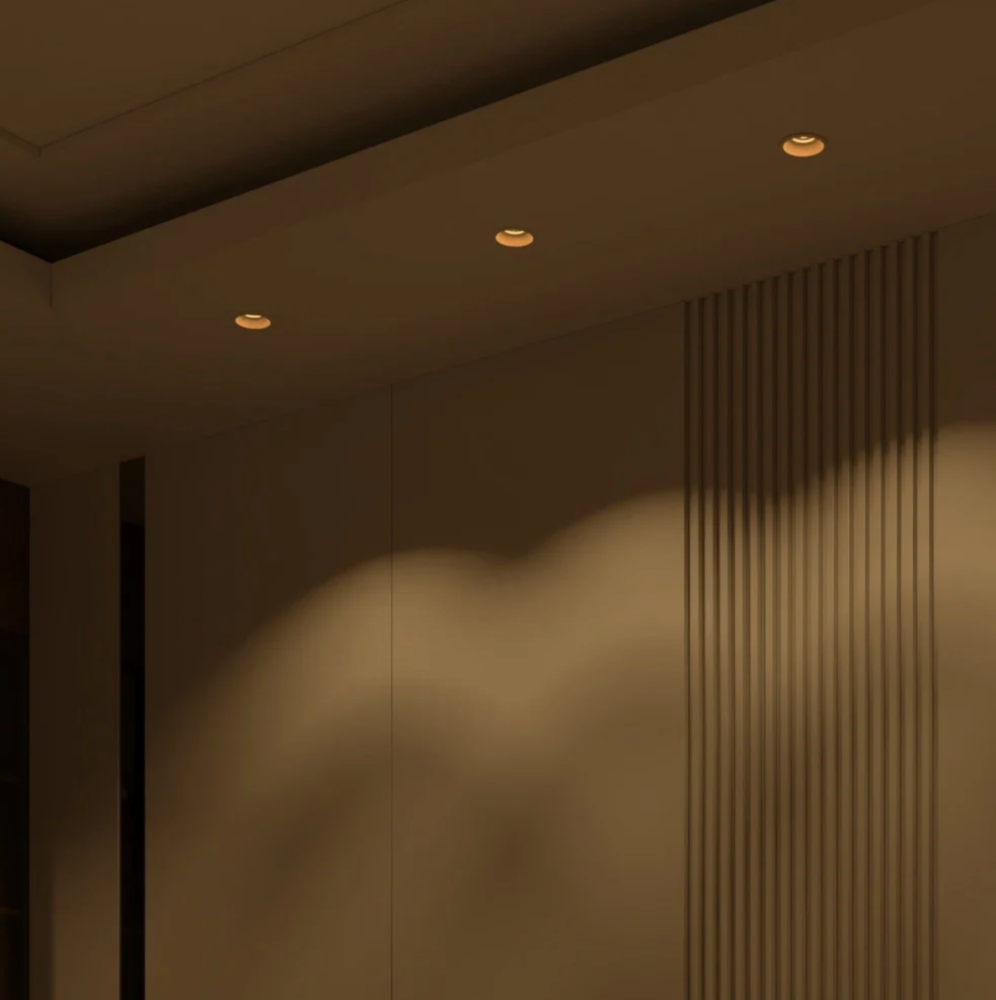
To distribute spotlights correctly, follow a practical rule: the spacing between spots depends on the ceiling height, with a smaller gap from the walls. Balanced distribution prevents dark spots and over-lighting, giving even, comfortable light.
Quick rule: Divide the ceiling height by about 2 to set the spacing between spots, and leave half that distance from walls. Example: a 2.8 m ceiling → about 1.2–1.5 m between spots, and about 0.6–0.75 m from the wall.
Why does correct distribution matter?
- Prevents dark spots between fixtures.
- Avoids over-lighting and glare.
- Gives a neat, elegant ceiling look.
The spacing rule between spots
The higher the ceiling, the larger the possible spacing between spots, because light spreads more before reaching the floor. As a general guide: spacing ≈ about half the ceiling height.
Distance from walls
Leave a gap from the wall equal to half the spacing between spots, to avoid wall shadows and distribute light evenly.
How to calculate the number of spots?
- Determine the room area (length × width).
- Calculate the required lumens (lux × area).
- Divide by the lumens per spot to find the count.
- Distribute them on a regular grid per the spacing rule.
Common layout patterns
- Regular grid: equal rows and columns for general lighting.
- Perimeter: around the room edges to highlight walls.
- Functional: concentrated over work areas (kitchen, office).
Common mistakes to avoid
- Too-large spacing, causing dark spots.
- Too-small spacing, causing over-lighting and glare.
- Ignoring the distance from walls, causing shadows.
- Irregular distribution, spoiling the ceiling look.
Tips for ideal distribution
- Draw the distribution grid on the ceiling plan before installing.
- Account for furniture positions and functional zones.
- Use a beam angle suited to the spacing.
Frequently asked questions
What is the ideal spacing between spots?
About half the ceiling height; for a 2.8 m ceiling, about 1.2–1.5 m.
How far from the wall should a spot be?
About half the spacing between spots (roughly 0.6–0.75 m).
How do I avoid dark spots?
Distribute evenly and mind the beam angle and ceiling height.
Conclusion
Correct lighting distribution depends on balanced spacing between spots (about half the ceiling height) and a suitable distance from walls. With upfront planning, you get even, elegant light with no dark spots.
Shop spotlights and plan your lighting distribution at tirtk Lighting & Electrical
Related: For correct spotlight and downlight spacing, pick from lighting, LED panels, and magnetic track lights at tirtk.